| The Home page of ILPI's Safety Data Sheet (SDS) Resource, the leader in SDS information since 1995! | |
| The history and philosophy behind this resource. | |
| A curated collection of books and reference materials concerning Safety Data Sheets and closely related topics. | |
| Paste your plain text SDS into the SDS-Demystifier, and it will be converted into a hypertext-enriched document with links to detailed explanations of each key term. | |
| An extensive list of frequently asked questions about Safety Data Sheets including regulations, content, compliance, and more. | |
| A humorous take on Safety Data Sheet jargon. Fill in the blanks on our entry form to generate a personalized Unsafety Data Sheet to share with your coworkers. | |
| Since 1995, we've maintained this massive curated list of the best places to find Safety Data Sheets on the Internet. | |
| Way more than a glossary, this hypertext-enhanced resource covers hundreds of SDS-related terms and expert knowledge. Each entry includes both the SDS relevance and links to additional authoritative resources. | |
| Archived results of Safety Data Sheet related polls taken by some of our millions of site visitors | |
| You are here! The OSHA regulations behind SDS regulations, including the inspection guidelines and over 400 official interpretations letters under the Hazard Communication Standard | |
| Commercial suppliers of SDS authoring and management software as well as cloud compliance services. | |
| Commercial companies that will create SDS's for your specific needs as well as SDS translation companies. |

Safety signs, banners, and scoreboards? Get yours at Safety Emporium!
OSHA Hazard Communication Letters of Interpretation
MSDS's must be provided to employees who package/process drugs for distribution into final form if they contain hazardous chemicals
- Issued
- Record type
- Interpretation
- Historical standard
- HCS 1994, pre-GHS archive
- Current standard
- HCS 2024, as amended
ILPI assessment: Generally consistent for the described repackaging work
This letter addresses the obsolete 1994 version of the Hazard Communication Standard (HCS). The conclusion concerns occupational processing and repackaging with potential exposure, not ordinary administration of intact solid-dose medication. FDA regulation does not by itself remove SDS and training duties.
Apply the complete drug exemption, the separate FDA-label exemption and SDS requirements. The drug exemption also includes drugs packaged for retail sale and drugs intended for employees’ personal consumption; the final sentence of this letter must not be read as eliminating those separate categories. Evaluate the actual work and hazardous ingredients.
Last reviewed: .
About this ILPI assessment
This comparison with current requirements is not a finding that OSHA has formally withdrawn this letter. This assessment reflects editorial judgment informed by human review and AI assistance. It is an opinion, may contain errors or omissions, and is not an official OSHA determination. For guidance on how OSHA requirements apply to your circumstances, contact your local OSHA office.
OSHA's notice about interpretation letters
The following notice is published on OSHA's interpretation pages; it is general guidance, not a letter-specific withdrawal notice.
OSHA requirements are set by statute, standards and regulations. Our interpretation letters explain these requirements and how they apply to particular circumstances, but they cannot create additional employer obligations. This letter constitutes OSHA's interpretation of the requirements discussed. Note that our enforcement guidance may be affected by changes to OSHA rules. Also, from time to time we update our guidance in response to new information. To keep apprised of such developments, you can consult OSHA's website at https://www.osha.gov.
Source: OSHA's original letter page.
February 8, 2005
Ms. Monica Dahlem
Environmental, Safety and Health Consultant
107 Meadow Glen Way
Achworth, GA 30101
Dear Ms. Dahlem:

Get your PPE such as made in USA NIOSH-approved N95 masks from Safety Emporium.
Thank you for your April 6, 2004 letter to the Occupational Safety and Health Administration's (OSHA's) Office of Evaluation and Analysis. Your letter was forwarded to OSHA's Directorate of Enforcement Programs (DEP), we received it on April 28, 2004. We apologize for the delay in responding to your request for clarification. This letter constitutes OSHA's interpretation only of the requirements discussed and may not be applicable to any statement or scenario not delineated within your original correspondence. Specifically, you requested information regarding 29 CFR 1910.1200, OSHA's Hazard Communication Standard (HCS) [ILPI: Original HCS 1994 context · Current HCS], as it relates to drugs and Material Safety Data Sheets (MSDSs). Your paraphrased question and our response are provided below.
Question: Stericycle Pharmaceutical Returns Center (SPRC) processes prescription and over the counter drugs in their final form for distribution. These drugs are in the forms of tablets, pills, capsules, ointments, creams, gels, injections, and liquids. Would SPRC be exempt from the MSDS requirement under 29 CFR 1910.1200(b)(6)(vii) [ILPI: Original HCS 1994 context · Current HCS]?
Response: SPRC is not exempt from the MSDS requirement and must provide MSDSs to those employees exposed to drugs containing hazardous chemicals, as defined by the HCS [ILPI: Original HCS 1994 context · Current HCS]. In your letter you stated that SPRC employees are engaged in activities such as pouring and measuring liquid drugs and counting tablets and pills for packaging and processing.
SPRC is therefore considered a "chemical manufacturer" under the HCS [ILPI: Original HCS 1994 context · Current HCS], which defines this term as "an employer with a workplace where chemical(s) are produced for use or distribution." The term "produce" under the HCS means to "manufacture, process...or repackage" [29 CFR 1910.1200(c) [ILPI: Original HCS 1994 context · Current HCS]]. Because SPRC is considered a chemical manufacturer under the HCS and the potential for exposure exists, employees are entitled to the information that is contained on the MSDSs.
In addition, the exemption under paragraph (b)(6) of the standard [ILPI: Original HCS 1994 context · Current HCS] states that the HCS [ILPI: Original HCS 1994 context · Current HCS] does not apply to "Any drug...in solid final form for direct administration to the patient..." The intent of the HCS is to protect employees from hazardous exposures. In the situation you described, employees are counting tablets, pills, and capsules in preparation for packaging and are, therefore, handling the drugs in a manner that would potentially result in exposure to the dust from crumbled pills, tablets, or capsules. Where there is potential for exposure, employees are covered by the standard and have the right to know the hazards of the chemicals to which they are exposed. The same principle applies to the processing of any liquids, injections, gels, and ointments, for which there is no exemption under the HCS [ILPI: Original HCS 1994 context · Current HCS].
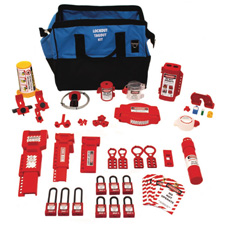
When working around hazardous sources of energy, OSHA requires the use of lockout devices like these from Safety Emporium.
[ILPI note: At issuance: HCS 1994, pre-GHS archive. This conclusion addresses the described occupational processing. The complete drug exemption also covers specified retail-packaged and personal-use drugs; FDA labeling is a separate exemption.]
Thank you for your interest in occupational safety and health. We hope you find this information helpful. OSHA requirements are set by statute, standards, and regulations. Our interpretation letters explain these requirements and how they apply to particular circumstances, but they cannot create additional employer obligations. From time to time we update our guidance in response to new information. To keep apprised of such developments, you can consult OSHA's website at https://www.osha.gov. If you have any further questions, please feel free to contact the Office of Health Enforcement at (202) 693-2190.
Sincerely,
Richard E. Fairfax, Director
Directorate of Enforcement Programs
The original official public domain version of this document is available from OSHA at https://www.osha.gov/laws-regs/standardinterpretations/2005-02-08-0.