| The Home page of ILPI's Safety Data Sheet (SDS) Resource, the leader in SDS information since 1995! | |
| The history and philosophy behind this resource. | |
| A curated collection of books and reference materials concerning Safety Data Sheets and closely related topics. | |
| Paste your plain text SDS into the SDS-Demystifier, and it will be converted into a hypertext-enriched document with links to detailed explanations of each key term. | |
| An extensive list of frequently asked questions about Safety Data Sheets including regulations, content, compliance, and more. | |
| A humorous take on Safety Data Sheet jargon. Fill in the blanks on our entry form to generate a personalized Unsafety Data Sheet to share with your coworkers. | |
| Since 1995, we've maintained this massive curated list of the best places to find Safety Data Sheets on the Internet. | |
| Way more than a glossary, this hypertext-enhanced resource covers hundreds of SDS-related terms and expert knowledge. Each entry includes both the SDS relevance and links to additional authoritative resources. | |
| Archived results of Safety Data Sheet related polls taken by some of our millions of site visitors | |
| You are here! The OSHA regulations behind SDS regulations, including the inspection guidelines and over 400 official interpretations letters under the Hazard Communication Standard | |
| Commercial suppliers of SDS authoring and management software as well as cloud compliance services. | |
| Commercial companies that will create SDS's for your specific needs as well as SDS translation companies. |

Safety signs, banners, and scoreboards? Get yours at Safety Emporium!
OSHA Hazard Communication Letters of Interpretation
Twenty-four hour coverage for emergency telephone numbers.
- Issued
- Record type
- Interpretation
- Historical standard
- 1910.1200, original 1983 rule (PDF)
- Current standard
- HCS 2024, as amended
ILPI assessment: Partly superseded: labels now require a phone number
This letter addresses the original 1983 Hazard Communication Standard (HCS), which is now obsolete. Its central point that the HCS does not impose a universal requirement for a 24-hour emergency line remains consistent with current OSHA guidance. However, the statement that a telephone number is required on MSDSs but not labels is obsolete: current shipped-container labels require a U.S. telephone number for the manufacturer, importer or other responsible party. SDS Section 1 separately requires contact information and an emergency phone number.
Current OSHA inspection guidance allows an emergency number with restricted contact hours if those restrictions are stated on the SDS. The number must reach someone able to provide additional product information during the stated hours. This guidance does not turn an unanswered number with no explanation into adequate emergency contact information.
Transportation requirements are separate. Where applicable, 49 CFR 172.604 requires an emergency response telephone number monitored throughout transportation, including incidental storage, subject to that rule's exceptions. This letter does not waive those requirements.
Last reviewed: .
About this ILPI assessment
This comparison with current requirements is not a finding that OSHA has formally withdrawn this letter. This assessment reflects editorial judgment informed by human review and AI assistance. It is an opinion, may contain errors or omissions, and is not an official OSHA determination. For guidance on how OSHA requirements apply to your circumstances, contact your local OSHA office.
OSHA's notice about interpretation letters
The following notice is published on OSHA's interpretation pages; it is general guidance, not a letter-specific withdrawal notice.
OSHA requirements are set by statute, standards and regulations. Our interpretation letters explain these requirements and how they apply to particular circumstances, but they cannot create additional employer obligations. This letter constitutes OSHA's interpretation of the requirements discussed. Note that our enforcement guidance may be affected by changes to OSHA rules. Also, from time to time we update our guidance in response to new information. To keep apprised of such developments, you can consult OSHA's website at https://www.osha.gov.
Source: OSHA's original letter page.
September 4, 1985
Mr. Ramon A. Napal
Vice President, Human Resources
Carlisle Syntech Systems
Post Office Box 7000
Carlisle, Pennsylvania 17013
Dear Mr. Napal:
Thank you for your letter of July 26 regarding the Hazard Communication Standard (HCS) (29 CFR 1910.1200).
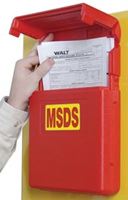
Many of our visitors use these weather-resistant SDS storage boxes like this one. We have 3 different sizes available at Safety Emporium.
A telephone number is required on material safety data sheets, not labels. [ILPI note: The “not labels” statement is obsolete. Current shipped-container labels require a U.S. contact number; SDS Section 1 also requires an emergency number.] The purpose of the number is to ensure that someone can "provide additional information on the hazardous chemical and appropriate emergency procedures, if necessary." The standard does not explicitly state that the telephone number must be answered on a twenty-four hour basis. It appears that some judgment must be made based upon the probable use of your products, and the potential for the occurrence of emergency situations that would require additional information. Many firms that produce highly toxic materials that are likely to be used by other employers during three-shift operations do provide twenty-four hour coverage of their emergency telephone numbers. Producers of mildly toxic materials, which are used in operations that proceed during normal working hours, would be less likely to have such coverage.
[ILPI note: Under current OSHA guidance, restricted emergency contact hours must be specified on the SDS. The number must reach someone able to provide product information during those hours. Separate transportation requirements may require monitoring throughout transportation.]
Since the HCS is a performance standard, a determination as to what is appropriate in your situation must be made by your firm. We hope this information is helpful to you. If we can be of further assistance, please do not hesitate to contact us.
Sincerely,Jennifer C. Silk
Health Scientist
Health Standards Programs
July 26, 1985
OSHA Administrator
Ms. Jennifer Silk
Room N3663
200 Constitution Avenue NW
Washington, D. C. 20210
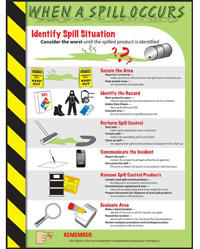
Train your employees to respond to emergencies with colorful workplace safety posters from Safety Emporium.
Dear Ms. Silk,
This letter is to request an official interpretation of the provision of the Right-To-Know Law that deals with labeling of products and information provided on Material Safety Data Sheets.
As you know, the Right-To-Know law requires both labels and MSDSs to list a telephone number. The question I am asking is - a twenty-four hour a day basis: We have made several phone calls, both to your office and to regional offices and have been told telephonically that the telephone does not have to be manned twenty-rour hours a day because the law does not specify such a requirement. We would appreciate, however, a written confirmation of that fact.
Sincerely,
CARLISLE SYNTEC SYSTEMS Ramon A. Nadal
Vice President
Human Resources
Carlisle SynTec Systems
Division of Carlisle Corporation
P.O. Box 7000
Carlisle, PA 17013
(717)245-7000
The original official public domain version of this document is available from OSHA at https://www.osha.gov/laws-regs/standardinterpretations/1985-09-04-0.